Moules-frites at the Braderie de Lille: recorded prices, quiet hours and tonnages nobody can check
Moules-frites (mussels and chips) are the meal of the Braderie de Lille, and the piles of shells outside restaurants its best-known image. The recorded prices, the times to eat without waiting, and why the tonnes of mussels quoted every year rest on no published figure.
Moules-frites, mussels with chips, are the dish of the Braderie de Lille. Restaurants serve them all weekend, and the empty shells pile up outside their fronts, in a sort of unspoken contest that photographers love.
Behind the image, the figures are missing. This page gives the recorded prices, the times to eat without waiting, and what the tonnages quoted every year are worth.
Why do people eat mussels at the Braderie de Lille?
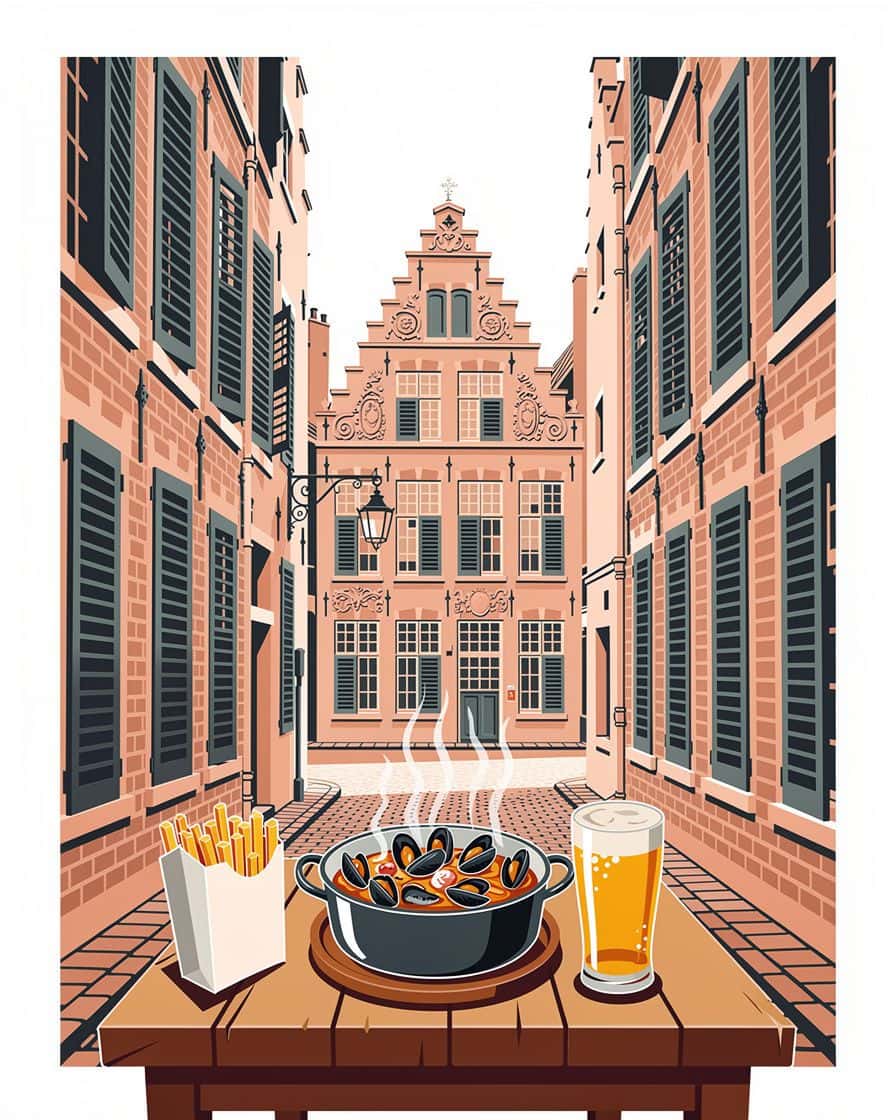
Because it has become the tradition, though no source consulted makes it possible to date its origin. The City links the word "braderie" to the Flemish braden, to roast, in memory of the merchants who sold poultry and grilled herring in the streets. Mussels do not feature in that story.
Their link with the event is therefore an established custom, not a documented historical rule. We present it as a symbol of Lille, not as something unique to it: no study compares the place of mussels in Lille and in the other braderies of northern France. The history of the event itself is on our page on the Grande Braderie.
How much does a portion of moules-frites cost?
| Area | Price recorded in 2024 |
|---|---|
| Grand'Place | €10.90 to €12.90 |
| Rue de Gand | €16.90 |
| Rihour area | €16.90 to €21.90 |
This survey, published by Soso Lesoir, is the only one available. It dates from 2024: no prices have been published for 2025 or 2026, and the City keeps no list of food prices during the event.
The price almost doubles between the Grand'Place and the Rihour area, and that comes down to the restaurant, not the dish. Extra charges for a terrace, a drink or a larger portion are documented nowhere. It is a ritual, not a bargain.
How many tonnes of mussels are eaten?
No verifiable figure is published. The tonnages quoted every year in tourism articles and on social media point to no review by the City, no survey of restaurateurs and no record from wholesalers.
The same silence covers the number of portions sold, the height of the shell piles and any ranking of restaurants. The City's 2026 review counts more than 2.5 million visitors and 5,425 exhibitors, and not a single mussel.
So we quote no tonnage. If a sourced figure appears, with its organisation and its method, it will go into this page with its year.
Mussels taste better without rushing: staying in the centre means you can have lunch at 11:15am and dinner after 9pm, when tables free up. For the braderie on Saturday 4 and Sunday 5 September 2027, rooms are still at normal prices.
See places to stay for the 2027 braderie → Partner link: booking through it supports the site at no extra cost to you.When can you eat mussels without waiting?
La Voix du Nord advises avoiding the 12:30pm to 1:30pm slot and aiming to eat before 11:30am or after 3pm, as restaurants serve all day that weekend. Saturday evening between 7pm and 9pm is the worst time of the year to get a seat on the Grand'Place.
At those times, waits of 30 to 60 minutes are common at the most visible places: this is an observation, as none of them publishes its waiting times. A place a little further out keeps you waiting less and often costs less, as we noted in our weekend itinerary for Lille.
At night, licensed venues could stay open until 5am on Saturday night in 2026. An open bar is not an open kitchen: for mussels, aim for the evening, not the night.
Where can you eat mussels during the braderie?
In the restaurants, brasseries and estaminets (traditional Flemish taverns) of the centre and Vieux-Lille, inside or on the terrace, sometimes to take away. The braderie sells no shared meal or set menu: each place sets its own menu, prices and booking rules.
No official map of the restaurants serving mussels exists. In 2026, 18 extra food trucks added to the street food on offer, mostly for chips. A restaurant may also close for the whole weekend without warning: that is the subject of our page on restaurants closed during the braderie.
Tasting Lille another way: a food tour of Vieux-Lille introduces cheeses, beers and Flemish specialities away from the mussel queue. Slots can be booked online, with free cancellation in most cases.
See food tours and activities in Lille → Partner link: booking through it supports the site at no extra cost to you.What do we know, and what don't we know?
We know the 2024 prices, the times recommended by the local press and the permitted opening hours of venues. We know neither the tonnages, nor the portions, nor the 2026 prices, nor the documented origin of the tradition.
The rest of the weekend, official figures and crowd times included, is on our page on the Braderie de Lille.
Sources
Soso Lesoir (moules-frites prices during the 2024 braderie). La Voix du Nord (5 September 2026, mealtimes). Lilleaddict (28 August 2026). lille.fr: Braderie 2026 bilan en chiffres, Tout savoir sur la Braderie de Lille 2026, Recette pour une Braderie réussie, history of the braderie. France 3 Hauts-de-France (20 August 2026, food trucks).
No official record of the mussels eaten has been found: the tonnages quoted every year are not repeated here. Waiting times are observations. Research consolidated on 28 September 2026.
Frequently asked questions
How much are moules-frites during the Braderie de Lille?
How many tonnes of mussels are eaten at the Braderie de Lille?
When can you eat mussels at the braderie without queuing?
Élise Vandamme
Born in Roubaix, Élise has covered the braderie for eleven editions, from the setting up of the stalls to the clearing of the mussel shells on Sunday evening. She knows the streets where you can still get through at 3pm and the ones you should no longer head into. Her rule: never recommend a time slot she has not tested herself.